
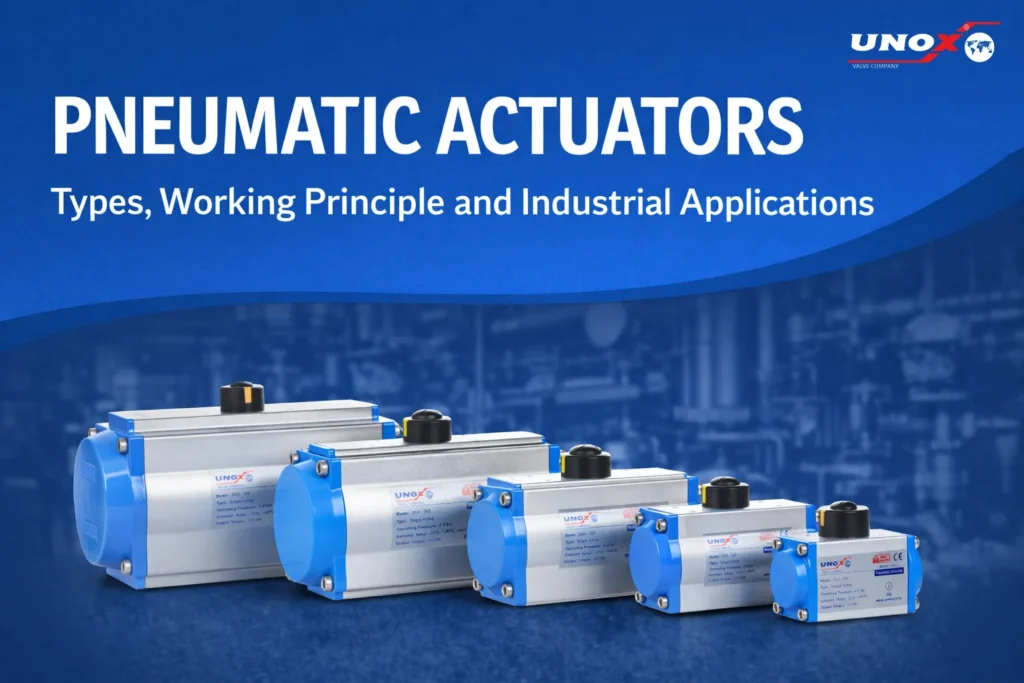
Pneumatic actuators are essential components in industrial automation systems. They convert compressed air energy into mechanical motion and are widely used to automate quarter-turn valves such as butterfly valves and ball valves, as well as linear control elements in certain process applications. Their fast response, reliable operation and compatibility with harsh environments make them one of the most preferred actuator types in modern plants.
In this guide, we explain what pneumatic actuators are, how they work, the different actuator types, the difference between double acting and spring return models, how torque is calculated, which accessories are commonly used, and how to choose the right pneumatic actuator for your application.
Contents
-
- What Is a Pneumatic Actuator?
- How Does a Pneumatic Actuator Work?
- Types of Pneumatic Actuators
- Double Acting vs Spring Return
- Pneumatic Actuator Torque
- Common Accessories
- Industrial Applications
- Standards and Mounting Interfaces for Pneumatic Actuators
- Maintenance and Service Life
- Compressed Air Powered Valve Automation in Industry
- Advantages of Air Powered Automation Systems
- Integration with Industrial Automation Systems
- How to Select the Right Pneumatic Actuator
- Pneumatic vs Electric Actuators
- Comparison Tables
- FAQ
What Is a Pneumatic Actuator?
A pneumatic actuator is a mechanical device that uses compressed air to create rotary or linear motion. In industrial valve automation, pneumatic actuators are commonly used to operate quarter-turn valves such as butterfly valves and ball valves. They are also used in dampers, process equipment, and on-off or modulating control systems.
Because compressed air is widely available in industrial facilities, pneumatic actuators offer a practical, fast and dependable automation solution. They are especially popular in environments where electrical devices may be less desirable due to heat, moisture, heavy cycling, or general plant conditions.
Most quarter-turn pneumatic actuators are designed according to common mounting standards such as ISO 5211 and DIN 3337, allowing easy integration with industrial valves and accessories.
How Does a Pneumatic Actuator Work?
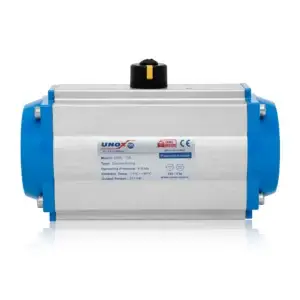
The working principle of a pneumatic actuator is based on air pressure acting on pistons or diaphragms inside the actuator body. When compressed air enters the actuator chamber, it pushes internal moving parts and generates torque or linear force. This motion is transferred to the valve stem, opening or closing the valve.
For quarter-turn actuators, internal pistons move in opposite directions and rotate a pinion gear, converting linear piston movement into rotary motion. This is why rack and pinion pneumatic actuators are the most common design for automated butterfly and ball valves.
The basic operation is simple:
- Compressed air enters the actuator
- Internal pistons move
- Motion is converted into torque
- The valve stem rotates
- The valve opens or closes
In spring return models, springs provide automatic fail-safe movement when air supply is removed. In double acting models, compressed air is used for both opening and closing strokes.
Types of Pneumatic Actuators
Pneumatic actuators are generally categorized by motion type, internal mechanism, and return function.
Quarter-Turn Pneumatic Actuators
These actuators rotate the output shaft by 90 degrees and are commonly used with:
- Butterfly valves
- Ball valves
- Plug valves
Linear Pneumatic Actuators
These generate linear movement and are commonly used on control valves and process regulating equipment.
Rack and Pinion Pneumatic Actuators
Rack and pinion actuators are widely used for quarter-turn valves. Two pistons move linearly inside the body and rotate a central pinion shaft. This design is compact, efficient and ideal for butterfly valves and ball valves.
Main advantages:
- Compact structure
- Fast response
- Easy mounting
- Good torque-to-size ratio
Scotch Yoke Pneumatic Actuators
Scotch yoke actuators are generally used in larger torque applications. They provide a torque curve that can better match valve breakaway torque requirements, especially for large ball valves and severe service conditions.
Main advantages:
- High torque output
- Better breakaway performance
- Suitable for large valves
Double Acting vs Single Acting (Spring Return)
One of the most important selection decisions is whether the actuator should be double acting or spring return.
Double Acting Pneumatic Actuators
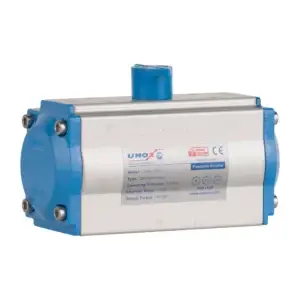
Double acting actuators use compressed air for both opening and closing movement. They do not contain fail-safe springs.
Advantages:
- Higher torque output in compact size
- Suitable for frequent cycling
- Good for stable air supply systems
Typical uses:
- General industrial automation
- Butterfly valves
- Ball valves
- On-off systems with continuous air supply
Single Acting (Spring Return) Pneumatic Actuators
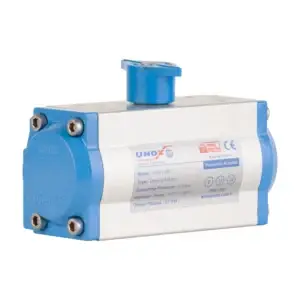
Spring return actuators use compressed air in one direction and internal springs in the opposite direction. This provides a fail-safe function when air supply is lost.
Advantages:
- Fail-open or fail-closed operation
- Improved safety in critical systems
- Useful in emergency shutdown applications
Typical uses:
- Safety systems
- Emergency shutdown valves
- Critical utility lines
The choice depends on process safety, torque needs and what should happen if compressed air supply fails.
Pneumatic Actuator Torque
Torque is one of the most important criteria when choosing a pneumatic actuator. The actuator must generate enough torque to overcome the valve’s resistance under all operating conditions.
Valve torque is not constant. It usually varies depending on:
- Valve type
- Seat material
- Fluid pressure
- Temperature
- Media characteristics
- Operating frequency
When selecting an actuator, engineers usually consider:
- Breakaway torque – torque required to start movement
- Running torque – torque during travel
- End torque – torque required near closed/open end positions
A safety factor is typically added to ensure reliable operation. Pneumatic actuator sizing should never be based only on nominal valve torque without considering real working conditions.
For example, butterfly valves often require higher breakaway torque due to seat contact. Ball valves may require significant torque depending on seat load, pressure and fluid type.
Common Accessories
Pneumatic actuators are often installed with additional accessories to improve control, monitoring and safety.
Solenoid Valve
A solenoid valve controls the supply of compressed air to the actuator. It is one of the most common accessories in pneumatic automation. Coil voltage, port size, IP rating and response time must be selected correctly.
Limit Switch Box
A limit switch box provides open/closed position feedback to the control system. It is widely used in automated butterfly valves and ball valves.
Positioner
For modulating applications, a positioner is used to precisely control actuator position based on an input signal.
Air Filter Regulator
Compressed air quality strongly affects actuator performance. An air filter regulator is used to maintain clean and stable air supply pressure.
Manual Override
Some actuator systems include manual override mechanisms for operation during maintenance or control failure.
Industrial Applications
Pneumatic actuators are used in a wide variety of industries because they are fast, dependable and well suited for automated systems.
- Water and wastewater treatment – automated butterfly valves and isolation systems
- Compressed air systems – shut-off and distribution control
- Chemical processing – safe and repeatable valve operation
- HVAC systems – damper and valve automation
- Food and beverage – process utility automation
- Oil and gas – on-off and emergency shutdown systems
- Steam and thermal oil systems – automated isolation lines
In many plants, pneumatic actuators are selected because they perform well in demanding industrial conditions and can cycle rapidly with minimal downtime.
Standards and Mounting Interfaces for Pneumatic Actuators
Most industrial pneumatic actuators are designed according to international standards to ensure compatibility with different valve types and automation accessories. One of the most important standards is ISO 5211, which defines the mounting interface between the actuator and the valve. Thanks to this standardization, pneumatic actuators can be easily mounted on butterfly valves, ball valves and other quarter-turn valves without requiring custom adapters.
Another commonly used standard is NAMUR, which defines the interface for accessories such as solenoid valves and positioners. NAMUR mounting allows quick installation of control components directly on the actuator body, reducing tubing length and improving response time in automated systems. This modular structure makes pneumatic actuators highly adaptable in industrial automation environments.
Maintenance and Service Life
One of the major advantages of pneumatic actuators is their simple mechanical design and long service life. Compared with electric actuators, pneumatic systems contain fewer complex components, which makes them easier to maintain and highly reliable in demanding industrial environments.
Regular maintenance typically involves checking air supply quality, ensuring proper lubrication of internal moving parts and inspecting seals and O-rings. Clean, dry and properly filtered compressed air significantly extends actuator lifetime and prevents premature wear. With proper maintenance, pneumatic actuators can operate reliably for many years in applications such as chemical processing plants, water treatment facilities and industrial automation systems.
Compressed Air Powered Valve Automation in Industry
Compressed air has been one of the most widely used energy sources in industrial automation for decades. Systems powered by compressed air offer several advantages such as fast response time, high reliability and safe operation in hazardous environments. In many industrial plants, compressed air is already available as part of the facility infrastructure, which makes air-driven motion systems a practical and economical solution for automated valve control.
In valve automation systems, compressed air is used to generate mechanical movement that opens or closes a valve. The air pressure acts on internal pistons or diaphragms, converting air energy into rotational or linear motion. This motion is then transferred to the valve stem through a shaft or coupling mechanism. As a result, operators can control process flow remotely and automatically without manual intervention.
One of the major advantages of air-powered automation systems is their ability to operate in harsh industrial environments. Chemical plants, refineries, power plants and water treatment facilities often require equipment that can withstand humidity, dust, temperature fluctuations and potentially explosive atmospheres. Air-driven motion systems are well suited for these conditions because they do not rely on complex electrical components at the point of actuation.
Advantages of Air Powered Automation Systems
Air powered valve automation provides several operational advantages in industrial processes. First, compressed air systems are capable of delivering high force output with relatively compact mechanical designs. This allows large industrial valves to be operated efficiently even when high torque is required.
Another benefit is operational speed. Compressed air can rapidly move internal pistons, allowing valves to open or close quickly when required. Fast response is especially important in automated production lines and safety shutdown systems where immediate action may be necessary to prevent process disturbances or equipment damage.
Reliability is another key advantage. Compared with many electrically driven solutions, air powered motion systems typically have fewer electronic components exposed to industrial conditions. This reduces the risk of electrical failures and helps maintain stable operation even in challenging environments.
Integration with Industrial Automation Systems
Modern valve automation systems are designed to integrate easily with plant control infrastructure. Air-powered motion units are commonly used together with accessories such as solenoid valves, limit switch boxes, position indicators and air preparation units. These components allow operators and control systems to monitor valve position, regulate airflow and automate process control from centralized control panels or PLC systems.
In automated process plants, these systems play a critical role in maintaining safe and efficient operation. Automated valves can regulate flow rates, isolate sections of piping and control fluid distribution across complex industrial networks. By combining compressed air power with modern control systems, facilities can achieve precise process management while minimizing manual intervention.
For industries such as chemical processing, food production, water treatment and energy generation, air powered valve automation remains one of the most dependable solutions for reliable and cost-effective process control.
How to Select the Right Pneumatic Actuator
Choosing the right actuator requires more than simply matching valve size. The following parameters should be evaluated carefully:
Pneumatic Actuator Selection Checklist
- Valve type: butterfly valve, ball valve, plug valve or control valve
- Required torque: including breakaway and safety factor
- Actuator type: rack and pinion or scotch yoke
- Function: double acting or spring return
- Air supply pressure: available instrument air pressure
- Mounting standard: ISO 5211 / DIN 3337 compatibility
- Control accessories: solenoid valve, limit switch box, positioner
- Installation environment: indoor, outdoor, corrosive, humid, dusty
- Operating frequency: cycle rate and duty conditions
- Fail-safe requirement: fail-open or fail-closed behavior
If actuator sizing is too small, the valve may fail to operate under pressure. If oversized unnecessarily, cost and air consumption increase. Correct sizing is essential for long-term reliability.
Pneumatic vs Electric Actuators
Both pneumatic and electric actuators are widely used in valve automation. The best choice depends on the application.
| Feature | Pneumatic Actuator | Electric Actuator |
|---|---|---|
| Response speed | Fast | Moderate |
| Power source | Compressed air | Electrical power |
| Fail-safe capability | Excellent with spring return | Possible but design dependent |
| Maintenance | Low to moderate | Moderate |
| Best for | Fast on-off valve automation | Locations without air supply |
Pneumatic actuators are usually preferred in high-cycle industrial environments, while electric actuators are common where compressed air is not available.
Comparison Tables
Pneumatic Actuator Type Comparison
| Type | Advantages | Typical Applications |
|---|---|---|
| Rack and Pinion | Compact, fast, easy to mount | Butterfly valves, ball valves |
| Scotch Yoke | High torque, better breakaway curve | Large ball valves, heavy-duty service |
| Spring Return | Fail-safe movement | Emergency shutdown systems |
| Double Acting | Higher torque, fast repeated cycling | General on-off automation |
Accessory Overview
| Accessory | Function | Importance |
|---|---|---|
| Solenoid Valve | Directs compressed air to actuator | Essential for automated control |
| Limit Switch Box | Provides open/closed position feedback | Important for monitoring |
| Positioner | Controls actuator position precisely | Needed for modulating control |
| Filter Regulator | Maintains clean and stable air supply | Improves reliability |
Need Help Choosing the Right Pneumatic Actuator?
Tell us your valve type, torque requirement, air pressure and control preferences. Our team can help you select the best UNOX automation solution.
Related Articles
- Butterfly Valves: Industrial Flow Control Solutions
- Ball Valves: Complete Guide to Types, Applications and Selection
- Solenoid Valves: Complete Guide to Working Principle, Types, Applications and Selection
- Steam Traps: Types, Working Principles & Selection Guide
Frequently Asked Questions (FAQ)
What is a pneumatic actuator used for?
A pneumatic actuator is used to automate valves and equipment by converting compressed air into mechanical motion. It is commonly used for butterfly valves, ball valves and industrial on-off systems.
How does a pneumatic actuator work?
It works by directing compressed air into internal chambers, moving pistons or diaphragms to create rotary or linear motion that operates the valve.
What is the difference between double acting and spring return pneumatic actuators?
Double acting actuators use air for both directions of movement, while spring return actuators use air in one direction and springs in the opposite direction for fail-safe operation.
Which valves are commonly automated with pneumatic actuators?
Pneumatic actuators are most commonly used with butterfly valves, ball valves and some plug valves and control valves.
What is a rack and pinion pneumatic actuator?
A rack and pinion actuator uses piston movement to rotate a central pinion shaft, creating quarter-turn output for automated valves.
What is a scotch yoke actuator used for?
Scotch yoke actuators are used in higher torque applications, especially for larger valves and heavy-duty industrial service.
How do I calculate the correct pneumatic actuator torque?
You should consider valve breakaway torque, running torque, end torque, operating pressure and add a proper safety factor for reliable performance.
What accessories are used with pneumatic actuators?
Common accessories include solenoid valves, limit switch boxes, positioners, air filter regulators and manual override units.
What is the difference between pneumatic and electric actuators?
Pneumatic actuators use compressed air and are usually faster, while electric actuators use electrical power and are often chosen where compressed air is not available.
Why choose UNOX pneumatic actuators?
UNOX pneumatic actuators are designed for industrial reliability, strong torque output and compatibility with automated valve systems and common accessory standards.