
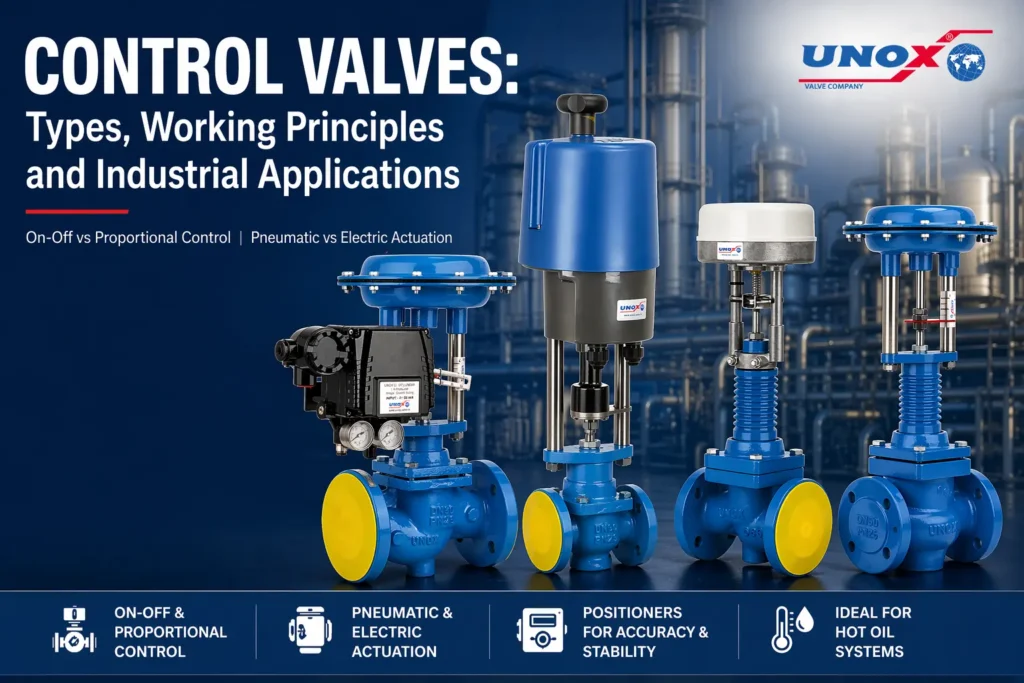
Control valves are among the most important components in industrial flow control systems. While many valves are used simply to stop or start flow, a control valve is designed to regulate flow continuously and accurately according to process requirements. In other words, it is not only a shut-off device but also a process control element that helps maintain stable pressure, temperature, level and flow in industrial systems.
In modern automation, control valves are used in steam systems, hot oil lines, water treatment plants, chemical processes, food production systems, compressed air networks and many other industrial applications. Their main purpose is to respond to a control signal and adjust the valve opening position in order to keep the process at the desired setpoint.
This guide explains what control valves are, how they work, the difference between on-off and proportional control, pneumatic and electric control valve options, the role of positioners, and how to select the right solution for an industrial application. If you work with process automation, steam systems or industrial flow control, understanding control valves is essential.
Contents
- What Is a Control Valve?
- How Do Control Valves Work?
- Control Valve Working Principle Video
- Main Components of a Control Valve
- On-Off vs Proportional Control
- Types of Control Valves
- Pneumatic Control Valves
- Electric Control Valves
- Control Valves for Hot Oil Systems
- What Is a Positioner and Why Is It Important?
- Industrial Applications
- How to Select the Right Control Valve
- Comparison Tables
- Maintenance and Performance Considerations
- Frequently Asked Questions
What Is a Control Valve?
A control valve is a valve that regulates the flow rate, pressure or direction of a fluid by changing the opening position of the internal trim in response to a control signal. Unlike a simple manual valve, which is usually either fully open or fully closed, a control valve can move to intermediate positions in order to maintain process stability.
In most industrial systems, control valves are connected to an automation loop. A sensor measures a process variable such as temperature, pressure, level or flow. That signal is sent to a controller, and the controller sends an output signal to the valve actuator. The valve then changes position accordingly. This closed-loop behavior is what makes control valves essential in process control systems.
For example, in a steam heating system, the process may require a specific outlet temperature. A temperature sensor measures the actual temperature, compares it to the target value and sends a control signal that opens or closes the valve gradually. The more accurate the valve movement, the more stable the process becomes.
Control valves are not limited to steam. They are widely used with water, thermal oil, air, inert gases, chemicals and industrial utilities. Their importance is especially high in systems where energy efficiency, process consistency and safety are critical.
How Do Control Valves Work?
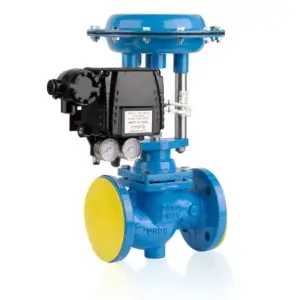
The working principle of a control valve is based on controlled restriction of flow. The valve body contains an internal closure element such as a plug, disc, ball or cage that moves relative to a seat. As the actuator changes the position of this trim, the effective flow area changes, which adjusts the amount of fluid passing through the valve.
The valve itself is only one part of the control process. In a typical system, the sequence is as follows:
- A process variable is measured by a sensor.
- The controller compares the measured value with the setpoint.
- The controller sends an output signal such as 4-20 mA or a pneumatic signal.
- The actuator receives the signal and changes valve position.
- Flow changes, and the process variable moves toward the desired value.
This means the control valve is a final control element. It receives instructions from the automation system and physically changes the process. Without a properly selected valve, even the best control system cannot maintain stable operation.
The accuracy of this process depends on valve sizing, actuator selection, signal stability and position feedback. If the valve is oversized, it may respond too aggressively. If undersized, it may never achieve the required flow. If the actuator is weak or the positioner is not tuned correctly, control quality can be poor. That is why control valve selection is both a mechanical and an automation engineering task.
Control Valve Working Principle Video
The video below explains the basic working principle of a steam control valve and shows how valve position affects process control. This is especially useful for understanding how control signals, actuators and internal valve movement work together in real applications.
Main Components of a Control Valve
A typical control valve system includes several important components:
- Valve body: the pressure-containing shell that defines connection type and pressure class.
- Trim: internal flow-controlling parts such as plug, seat, cage and stem.
- Actuator: pneumatic or electric device that moves the valve stem.
- Positioner: control accessory that ensures the actuator reaches the correct position according to the signal.
- Bonnet and packing: components that guide the stem and prevent external leakage.
- Controller signal: usually 4-20 mA, pneumatic or digital control signal from automation system.
The geometry of the trim strongly affects control performance. For example, a linear trim characteristic may provide proportional flow change with stem movement, while equal percentage trim provides finer control at lower openings and larger flow increase at higher openings. Trim design must be selected according to system dynamics and desired control behavior.
On-Off vs Proportional Control
One of the most important distinctions in industrial valve automation is the difference between on-off control and proportional control.
On-Off Control
An on-off control valve has only two working positions: fully open or fully closed. It is used to start or stop flow, isolate a section of piping, or perform simple switching operations. On-off valves are common in utility lines, compressed air systems and basic automation tasks.
For example, a solenoid valve controlling water flow to a machine is usually an on-off device. The signal is binary, and the valve either opens completely or closes completely.
Proportional Control
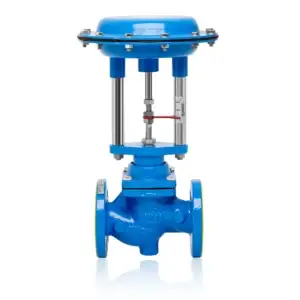
A proportional control valve can move to any position between fully closed and fully open. Instead of only switching flow on or off, it continuously regulates flow according to process demand. This is essential in systems where stable process conditions must be maintained, such as steam temperature control, hot oil heating circuits, flow balancing lines or pressure regulation loops.
In proportional control, valve movement is gradual and controlled. A 4-20 mA signal, for example, may correspond to 0% to 100% travel. The valve responds continuously, not just in two positions.
This is the key reason why control valves are different from ordinary shut-off valves. A simple on-off valve may automate isolation, but a proportional valve automates process quality.
Types of Control Valves
There are different valve types used for control service, and the best choice depends on media, pressure drop, required flow characteristic and shut-off demands.
Globe Control Valves
Globe valves are the most common type for precise process control. Their linear motion and plug/seat design make them suitable for accurate modulation. They are widely used in steam, hot oil, gas and liquid service where stable regulation is required.
Ball Control Valves
Specially characterized ball valves can be used for control duty in some systems. They offer compact design and relatively low pressure drop, but not all ball valves are suitable for modulating control. Standard on-off ball valves are not the same as characterized control ball valves.
Butterfly Control Valves
Butterfly valves are often used in large line sizes. When combined with proper actuation and control accessories, they can provide proportional flow regulation in water, HVAC and certain industrial systems. However, their control precision depends on disc geometry, seat design and torque characteristics.
Angle and Special Pattern Valves
In some systems, angle-style or specially configured bodies are used to reduce turbulence, manage flashing or fit installation limitations.
Pneumatic Control Valves
A pneumatic control valve uses compressed air to move the actuator and position the valve. These systems are widely used in industry because they are reliable, fast and suitable for harsh conditions.
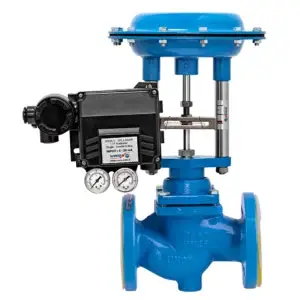
In most cases, the pneumatic actuator is connected to an electro-pneumatic positioner. The control system sends a 4-20 mA signal to the positioner, and the positioner converts that signal into controlled air pressure applied to the actuator. This allows precise positioning of the valve stem.
Pneumatic systems offer several advantages:
- Fast response time
- Good fail-safe options with spring return designs
- Strong output force
- Suitability for demanding industrial environments
- Wide use in steam and process industries
Pneumatic control valves are especially popular in steam systems, thermal oil systems, chemical plants and continuous industrial processes where stable control and fail-safe behavior are important.
Electric Control Valves
An electric control valve uses an electric actuator to move the valve trim. Instead of compressed air, it relies on an electric motor and gear train to position the valve according to the control signal.
Electric control valves are often preferred where compressed air is not available or where electrical infrastructure is already dominant. They are common in building automation, remote installations, packaged systems and applications where air supply would increase system complexity.
Advantages of electric designs include:
- No need for instrument air
- Simple electrical integration
- Good for remote sites
- Compact installation for certain duties
However, electric actuators may respond more slowly than pneumatic systems, and proper environmental protection must be considered in wet, hot or corrosive environments.
Control Valves for Hot Oil Systems
Hot oil systems require precise temperature control and reliable shut-off performance because thermal oil carries high energy and operates at elevated temperatures. In these systems, control valves are used to regulate the flow of hot oil to heat exchangers, reactors, industrial ovens, drying systems and other process equipment.
Compared with water or low-temperature utility lines, thermal oil applications place greater demands on valve design, sealing materials and actuator reliability. The valve body, internal trim and stem sealing components must be suitable for continuous operation under high temperature conditions. Incorrect valve selection in a hot oil line can lead to unstable process temperatures, leakage risks and shortened equipment life.
In many hot oil systems, proportional control is essential. The valve must continuously adjust according to process demand in order to maintain stable outlet temperature and prevent overheating or insufficient heat transfer. This makes actuator response and positioner performance especially important. A properly selected positioner helps the valve move accurately and maintain the required opening position even when process conditions fluctuate.
For these applications, both pneumatic and electric control valve solutions may be used, depending on the system design and available utilities. Pneumatic options are often preferred in heavy industrial facilities where compressed air is available and fast response is required. Electric options can be useful in installations where air supply is limited or electrical integration is preferred.
When selecting a control valve for hot oil service, engineers should evaluate operating temperature, thermal oil type, viscosity, pressure drop, required flow rate and sealing material compatibility. Proper sizing and material selection are critical for long-term reliability and safe operation.
What Is a Positioner and Why Is It Important?
A positioner is one of the most important accessories used in control valve automation. Its basic job is to make sure the valve reaches and maintains the exact position required by the control signal.
Without a positioner, the actuator may not move accurately due to friction, pressure changes, spring forces, hysteresis or varying load conditions. The positioner compares the control signal with the actual valve stem position and continuously corrects any difference.
In simple terms, the positioner acts like an intelligent translator between the controller and the actuator.
- The controller says: “Move to 45% open.”
- The positioner checks the actual valve position.
- If the valve is only at 38%, it adjusts the air or motor command.
- The valve reaches the requested 45% accurately.
This improves several critical performance characteristics:
- Accuracy: better matching between signal and valve position
- Repeatability: the valve moves to the same position every time
- Speed: faster correction of position error
- Stability: less hunting and smoother process control
Positioners are especially important in proportional and modulating control systems. In on-off systems, they are usually not necessary. But in a steam temperature control loop or pressure control application, a good positioner can make the difference between unstable performance and reliable process control.
There are different types of positioners:
- Pneumatic positioners
- Electro-pneumatic positioners
- Smart digital positioners
Electro-pneumatic positioners are particularly common because they accept an electrical input signal, usually 4-20 mA, and use that signal to regulate air pressure sent to the actuator. Smart positioners can also provide diagnostics, calibration and communication functions.
Industrial Applications
Control valves are used in almost every industry where process conditions must be kept stable. Some of the most common applications include:
- Steam temperature control – regulating steam flow to heat exchangers and process equipment
- Hot oil systems – controlling thermal fluid flow to maintain target temperatures
- Water treatment – regulating flow and pressure in filtration or dosing systems
- HVAC systems – balancing chilled and hot water circuits
- Chemical processing – controlling process flow and reaction conditions
- Food and beverage production – maintaining process repeatability and hygiene conditions
- Compressed air and gas systems – pressure and flow regulation
In steam service, these valves are especially important because steam carries large amounts of energy. A small change in valve position can have a significant effect on heat transfer and system efficiency. That is why actuator and positioner selection must be done carefully.
How to Select the Right Control Valve
Control valve selection should never be based only on pipe size. A proper selection requires process data, fluid properties and control objectives.
Control Valve Selection Checklist
- Media type: steam, water, thermal oil, air, gas or chemicals
- Flow rate: normal, minimum and maximum operating flow
- Pressure: inlet pressure, outlet pressure and differential pressure
- Temperature: operating and peak temperature values
- Control type: on-off or proportional
- Fail action: fail-open, fail-closed or fail-in-place
- Valve characteristic: linear, equal percentage or quick opening
- Connection type: threaded, flanged or welded
- Actuation: pneumatic or electric
- Position feedback: positioner, switches, signal diagnostics
If the valve is oversized, control becomes unstable because small movements create large process changes. If undersized, the valve may never provide enough capacity. This is why proper sizing and Cv/Kv evaluation are essential in control valve engineering.
Use our Kv & Cv calculator to calculate Kv & Cv.
Comparison Tables
On-Off vs Proportional Control
| Feature | On-Off Control | Proportional Control |
|---|---|---|
| Valve position | Fully open / fully closed | Any intermediate position |
| Main use | Isolation and switching | Continuous process regulation |
| Signal type | Binary | Analog / proportional |
| Typical examples | Solenoid valve, shut-off valve | Steam control valve, modulating valve |
Pneumatic vs Electric Control Valves
| Feature | Pneumatic | Electric |
|---|---|---|
| Power source | Compressed air | Electrical power |
| Response time | Fast | Moderate |
| Fail-safe options | Excellent with spring return | Available but design dependent |
| Best for | Industrial process control | Applications without air supply |
Positioner Benefits Overview
| Function | Benefit |
|---|---|
| Signal-to-position correction | Improves valve accuracy |
| Feedback monitoring | Improves repeatability |
| Air pressure regulation | Improves dynamic response |
| Diagnostics (smart models) | Simplifies maintenance and tuning |
Maintenance and Performance Considerations
Even a correctly selected control valve can perform poorly if maintenance is neglected. Position drift, packing friction, poor air quality, unstable signals and incorrect tuning can all reduce control quality. Regular inspection of stem movement, actuator behavior, signal calibration and accessory performance helps maintain stable and efficient operation.
In steam systems, trim wear and condensate effects should also be monitored. In hot oil systems, sealing materials and thermal cycling must be considered carefully. Preventive maintenance is always more economical than process instability or unexpected shutdown.
Need Help Choosing the Right Control Valve?
Tell us your media type, pressure, temperature, flow rate and control requirements. Our team can help you select the best UNOX control valve solution for your application.
Related Articles
- Butterfly Valves: Industrial Flow Control Solutions
- Ball Valves: Complete Guide to Types, Applications and Selection
- Solenoid Valves: Complete Guide to Working Principle, Types, Applications and Selection
- Steam Traps: Types, Working Principles & Selection Guide
- Pneumatic Actuators: Complete Guide to Types, Working Principle and Industrial Applications
Frequently Asked Questions (FAQ)
What is a control valve used for?
A control valve is used to regulate flow, pressure, temperature or level in an industrial process by changing valve position according to a control signal.
How is a control valve different from a shut-off valve?
A shut-off valve is mainly used for full open or full closed operation, while a control valve is designed to modulate flow continuously and accurately.
What is the difference between on-off and proportional control?
On-off control uses only two positions, fully open or fully closed. Proportional control allows intermediate positions so the valve can regulate flow continuously.
Which actuator types are used with control valves?
Control valves can be operated by pneumatic or electric actuators depending on the process requirements and available utilities.
What is a positioner on a control valve?
A positioner is an accessory that ensures the valve stem reaches the correct position according to the control signal, improving accuracy and stability.
Why are positioners important in modulating systems?
They correct position error, improve repeatability and ensure the actuator responds precisely to the command signal, which is essential for stable process control.
Are butterfly and ball valves used as control valves?
Yes, certain butterfly and ball valve designs can be used for control service, but the trim and application requirements must be suitable for modulation.
Where are control valves commonly used?
They are commonly used in steam systems, thermal oil lines, HVAC systems, chemical processes, water treatment plants and industrial automation applications.
How do I choose the right control valve?
You should evaluate media type, pressure, temperature, flow rate, valve characteristic, actuation type and fail-safe requirements before selecting a control valve.
Can control valves be used in hot oil systems?
Yes, control valves are widely used in hot oil systems to regulate thermal oil flow and maintain stable process temperature. Proper material and seal selection is essential for high-temperature service.
Why choose UNOX control valves?
UNOX control valves are designed for reliable industrial performance, precise regulation and compatibility with automation systems used in steam, water and process applications.