
Contents
- What Is a Butterfly Valve?
- Working Principle
- Flow Characteristics
- Installation Guidelines
- Maintenance & Service Life
- Key Advantages of Butterfly Valves
- Types of Butterfly Valves
- Materials & Seat Options
- Actuated Butterfly Valves
- Industrial Applications
- How to Select a Butterfly Valve
- Common Mistakes
- Butterfly vs Other Valves
- FAQ
What Is a Butterfly Valve?
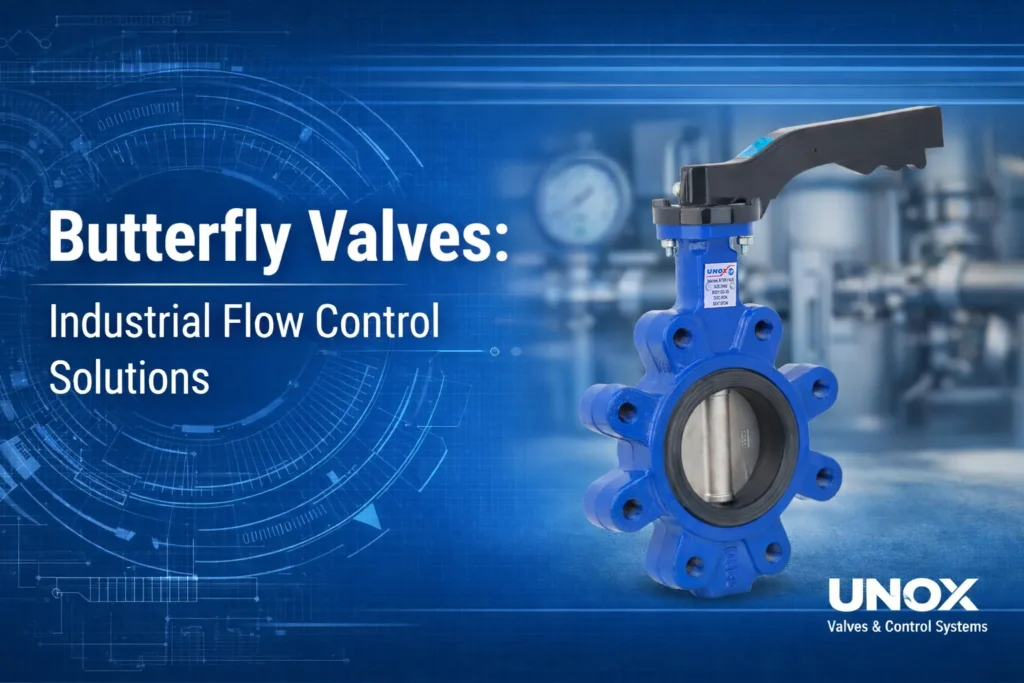
A butterfly valve is a quarter-turn rotary valve widely used for on-off and throttling applications in industrial systems. Its compact design, lightweight structure, and fast operation make it one of the most preferred valve types in HVAC, water treatment, steam, compressed air, and process industries.
Unlike gate or globe valves, butterfly valves regulate flow using a rotating disc positioned in the center of the pipe. This design provides quick shut-off, reduced pressure loss, and lower installation costs.
Working Principle
The working principle of a butterfly valve is based on a rotating disc mounted on a shaft. When the valve is fully open, the disc is positioned parallel to the flow, allowing fluid to pass with minimal resistance. When the valve is closed, the disc rotates 90 degrees and blocks the flow completely.
Unlike linear valves such as globe valves, butterfly valves operate using a quarter-turn mechanism. This makes them significantly faster in operation and highly suitable for automated systems.
In throttling applications, the disc can be positioned at intermediate angles to regulate flow. However, due to the geometry of the disc, the flow is not perfectly linear, and turbulence can occur depending on the valve opening percentage.
The sealing mechanism depends on the seat material. In soft-seated valves (EPDM, NBR), the disc presses against the elastomer seat to provide tight shut-off. In high-performance valves, PTFE or metal seats are used for higher temperature and pressure conditions.
Flow Characteristics
Understanding flow characteristics is essential when using butterfly valves for throttling applications. Unlike control valves, butterfly valves do not provide perfectly linear flow control. However, they are still widely used for flow regulation in many industrial systems.
The flow through a butterfly valve increases rapidly at small opening angles and becomes more stable as the valve approaches the fully open position. This behavior is often described as a non-linear or equal percentage characteristic.
- 0–20% Opening: Limited flow, high resistance
- 20–60% Opening: Rapid increase in flow
- 60–100% Opening: Stable and near full capacity
Because of this behavior, butterfly valves are not ideal for precise control applications. However, when combined with actuators and positioners, they can still be used effectively in semi-modulating systems.
For critical control applications, engineers typically prefer globe control valves, but butterfly valves remain a strong alternative due to their cost efficiency and compact design.
Installation Guidelines
Proper installation of butterfly valves is critical for ensuring leak-free operation and long service life. Incorrect installation can lead to premature wear, sealing issues, and operational inefficiencies.
- Installation Position: Can be installed horizontally or vertically
- Flow Direction: Typically bi-directional, but check manufacturer specs
- Alignment: Flanges must be aligned properly to avoid disc damage
- Clearance: Ensure enough space for disc rotation
- Gasket Selection: Compatible with fluid and temperature
It is recommended to install the valve slightly open during mounting to prevent damage to the seat and disc. Tightening bolts evenly is also essential to avoid distortion.
Maintenance & Service Life
Butterfly valves are known for their low maintenance requirements, but regular inspection is still necessary for optimal performance.
Routine maintenance includes checking for leakage, inspecting the seat condition, and verifying actuator performance in automated systems.
- Inspect sealing surfaces periodically
- Check actuator torque and operation
- Monitor pressure and temperature limits
- Replace seats when wear is detected
In clean service conditions, butterfly valves can operate for many years without major issues. However, in applications involving abrasive fluids or high temperatures, maintenance intervals should be shorter.
Proper material selection and correct installation significantly extend the service life of butterfly valves and reduce downtime in industrial operations.
Key Advantages of Butterfly Valves
Butterfly valves offer several advantages compared to other valve types:
- Compact & Lightweight Design – Requires less space and support
- Quick Operation – 90-degree turn from fully open to fully closed
- Cost-Effective – Lower material and installation costs
- Wide Size Range – Available from small DN sizes to large diameters
- Automation Ready – Easy integration with pneumatic and electric actuators
These benefits make butterfly valves ideal for both manual and automated systems.
Types of Butterfly Valves
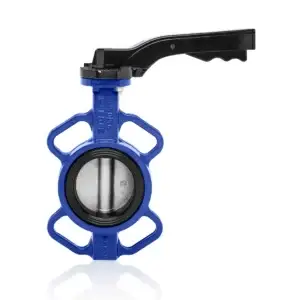
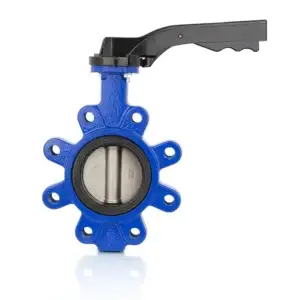
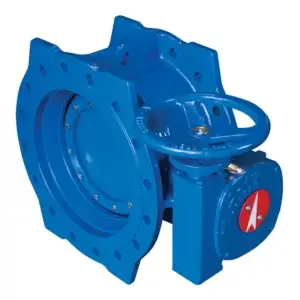
1. Wafer Type
Wafer type butterfly valves are designed to fit between two flanges. They are commonly used in HVAC, water distribution, and general industrial services due to their compact form and easy installation.
2. Lug Type
Lug type butterfly valves feature threaded inserts that allow dead-end service. This makes them suitable for systems requiring maintenance without shutting down the entire line.
3. Double Flanged & High Performance Butterfly Valves
These valves are used in higher pressure and temperature applications, offering enhanced sealing and longer service life.
| Feature | Wafer Type | Lug Type |
|---|---|---|
| Installation | Between flanges | Bolted to flanges |
| Dead-End Service | No | Yes |
| Cost | Lower | Medium |
| Typical Applications | HVAC, Water | Process Lines |
Materials & Seat Options
Selecting the right material is critical for long-term performance:
- Body Materials: Ductile Iron, Carbon Steel, Stainless Steel (AISI 304 / AISI 316)
- Disc Materials: Stainless Steel, Ductile Iron, Nickel Coated
- Seat Materials: EPDM, NBR, PTFE (Teflon)
Each combination is selected based on fluid type, temperature, and pressure conditions.
Actuated Butterfly Valves
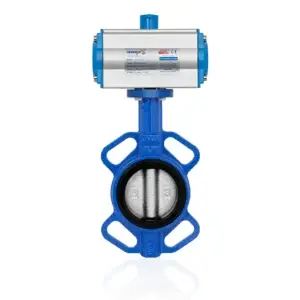
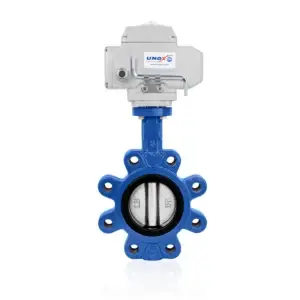
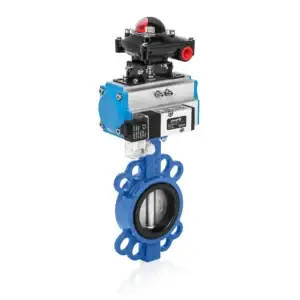
Butterfly valves can be automated using:
- Pneumatic Actuators (Double Acting / Spring Return)
- Electric Actuators (On-Off or Modulating)
- Accessories:
- Limit Switch Box
- NAMUR Solenoid Valves
- Positioners
Automated butterfly valves improve process control, safety, and operational efficiency in modern industrial facilities.
Common Industrial Applications
Butterfly valves are widely used in:
- Water & Wastewater Treatment Plants
- HVAC Systems
- Steam & Hot Oil Lines
- Chemical & Petrochemical Plants
- Food & Beverage Processing
- Compressed Air Systems
Their versatility makes them suitable for both low and medium pressure systems.
How to Select a Butterfly Valve
Selecting the correct butterfly valve is essential for ensuring long-term performance, reliability, and process efficiency. While butterfly valves are known for their simplicity, improper selection can lead to leakage, excessive wear, or poor flow control.
When choosing a butterfly valve, engineers must evaluate several key parameters including fluid type, pressure rating, temperature range, connection standard, and actuation requirements. Each of these factors directly affects the valve’s sealing performance and operational life.
- Media Type: Water, steam, air, chemicals or thermal oil
- Pressure: PN10, PN16, PN25 or ANSI Class ratings
- Temperature: Determines seat and sealing material
- Operation Type: Manual, pneumatic or electric
- Installation Space: Wafer vs lug vs flanged design
Common Mistakes When Selecting Butterfly Valves
Despite their simple design, butterfly valves are often incorrectly selected in industrial systems. These mistakes can result in performance issues, leakage, or reduced service life.
- Ignoring temperature limits: Using EPDM seats in high-temperature applications
- Wrong material selection: Choosing unsuitable materials for corrosive fluids
- Incorrect sizing: Oversized or undersized valves affecting flow control
- Improper actuator selection: Insufficient torque for automated systems
- Using standard valves in steam applications: Instead of high-performance designs
Avoiding these common mistakes ensures optimal system performance and reduces maintenance costs over time.
Butterfly Valve vs Other Valve Types
Butterfly valves are often compared with ball valves and gate valves. Each valve type has its own advantages depending on the application.
| Feature | Butterfly Valve | Ball Valve | Gate Valve |
|---|---|---|---|
| Operation | Quarter-turn | Quarter-turn | Multi-turn |
| Weight | Lightweight | Medium | Heavy |
| Cost | Low | Medium | High |
| Shut-off | Moderate | Excellent | Excellent |
| Best Use | Large diameter systems | High pressure systems | Isolation only |
In general, butterfly valves are preferred for large diameter pipelines, cost-sensitive projects, and automation applications, while ball valves are used where tight shut-off is critical.
For different flow control solutions, you may also explore
ball valves,
solenoid valves, and
control valves depending on your system requirements.
For automated systems, butterfly valves are often combined with actuators and accessories such as limit switch boxes and solenoid valves. In such applications, correct sizing and torque calculation become even more critical.
Why Choose UNOX?
At UNOX, we design and supply butterfly valves that meet international standards such as ANSI, DIN, PN, and ISO. Our products are engineered for durability, precise flow control, and seamless automation compatibility.
👉 Explore our full butterfly valve range on unoxus.com and contact our technical team for selection support.
Need Help Choosing the Right Butterfly Valve?
Tell us your media type, pressure, temperature, flow rate and control requirements. Our team can help you select the best UNOX butterfly valve solution for your application.
Frequently Asked Questions (FAQ)
What is a butterfly valve?
A butterfly valve is a quarter-turn rotary valve used to start, stop, or regulate flow in industrial piping systems. It is compact, lightweight, and suitable for automation.
What are butterfly valves used for?
Butterfly valves are used in water treatment, HVAC systems, steam lines, compressed air, chemical processing, and general industrial flow control applications.
Can butterfly valves be used for steam applications?
Yes, butterfly valves can be used for steam when designed as high-performance or metal-seated valves and selected according to pressure and temperature requirements.
What is the difference between a butterfly valve and a ball valve?
Butterfly valves are lighter and more cost-effective for large diameters, while ball valves offer tighter shut-off and are preferred for high-pressure applications.
Are butterfly valves suitable for automation?
Yes, butterfly valves are highly compatible with pneumatic and electric actuators, making them ideal for automated and remote-controlled systems.
What materials are butterfly valves made of?
Butterfly valves are commonly manufactured from ductile iron, carbon steel, and stainless steel, with EPDM, NBR, or PTFE seat options.
What is the difference between wafer type and lug type butterfly valves?
Wafer type butterfly valves are installed between flanges, while lug type butterfly valves allow dead-end service and easier maintenance.
Can butterfly valves be used for throttling?
Yes, butterfly valves can be used for throttling flow, although precise control depends on disc design and application conditions.
What pressure ratings are available for butterfly valves?
Butterfly valves are available in PN10, PN16, PN25, Class 150, and higher pressure ratings, depending on design and material.
How do I choose the right butterfly valve?
Choosing the right butterfly valve depends on fluid type, pressure, temperature, connection standard, and whether manual or automated operation is required.